
Barbie: Sustainable Branding

Project Overview:
To create and apply sustainable methodologies to innovative products, environments or services that transform current user needs and behaviors into meaningful
sustainable solutions.
Chosen Industry: Toy Industry
Chosen Brand: Barbie
Year
2023 (SCAD)
Category
Strategic Design
Type of Work
Design Research,
UX/UI,
Strategic Design,
Behavior Change,
Design for Impact,
Social Media Mktg &
Experience Design
Problem Statement:
The challenge was to create Barbie dolls that truly represent our diverse world and leverage them as educational tools for learning and sustainability awareness. This involves improving communication on Barbie's sustainability initiatives, establishing a circular economy, incorporating sustainable materials while maintaining aesthetic appeal, and enhancing packaging functionality for educational purposes.
My Role:
Lead Design Strategist & UX designer (Team Size: 4)
-
Conducting extensive brand research, performing detailed brand analysis
-
Strategizing design interventions aligned with research findings
-
Crafting the UX design for the application, and developing a compelling social media campaign.
-
Crafted the brand Identity and illustrations for the proposed design interventions.
Design Process:

Solution
Research Methods:
Secondary Research, Brand Analysis (Customer Persona, Value Proposition canvas, AUUDIO Analysis, Stakeholder Engagement Map, SWOT, Strategy Canvas, ERRC Analysis, Third Party Certificatio), Survey, In-depth Interviews, Cultural probe, Affinitization, How might we, Wireframes, Prototyping, Usability Testing
Research Timeline
Week 1
Project Kickoff
Initiated our research in the toy industry (particularly doll market), distinguishing purpose-driven from integrated brands. This insight-driven approach included an AUUDIO Analysis to align a brand's sustainability claims with its actions, aiding informed decision-making for the growth of genuinely sustainable brands.
Week 2
Secondary Research
Extensively examined Mattel's brand profile, particularly focusing on Barbie. We analyzed its mission, values, and market positioning, along with studying its primary competitors to understand the competitive landscape. Utilizing tools like SWOT analysis, strategy canvassing, and AUUDIO analysis, we gained insights into Barbie's strengths and areas for improvement, identifying strategic opportunities to enhance sustainability and competitive advantage.
Week 3-5
Primary Research
Methodology planning & Primary Research data collection, understand users through surveys, cultural probe, research assumptions and interviews
Week 6-7
Data Analysis
Analysis & synthesis, insight translation, insights to opportunities, design recommendations.
Week 8-10
Final Solution
Strategy and solution, feedback and reiterate, finalize deliverables
and project wrap-up
Information Gathering - Analysis Phase
The design process for the app started with the analysis phase which further had sub-activities such as contextual inquiry, contextual analysis for studying user behavior, from which gathered the needs of our system. We extracted requirements from contextual data. The requirements included interaction design requirements, inputs driving the design process for us to determine the features, look, feel and behavior of the interaction design.
It also shows recommended organization based on the user profile as I want to encourage the user to join more engage more with the brand.This will ensure that there is no conflict of interest and increases the chances of students getting involved.
Summary of Analysis:
-
Barbie doesn't have any third-party certificates.
-
Plastic pollution from product materials.
-
Fewer eco-education product.
-
Undesired dolls and packaging waste in landfills.
-
Barbie encourage customers to overconsume its product.
Target Audience - Personas And Scenarios
We identified two personas of different segments of individuals who might use our application.

Primary Research

Opportunities


Final Solution
New Brand Introduction
Overarching idea was to transform barbie into a sustainability advocate, where the principles of eco conscious learning is integrated into its ecosystem.

User Journey Map

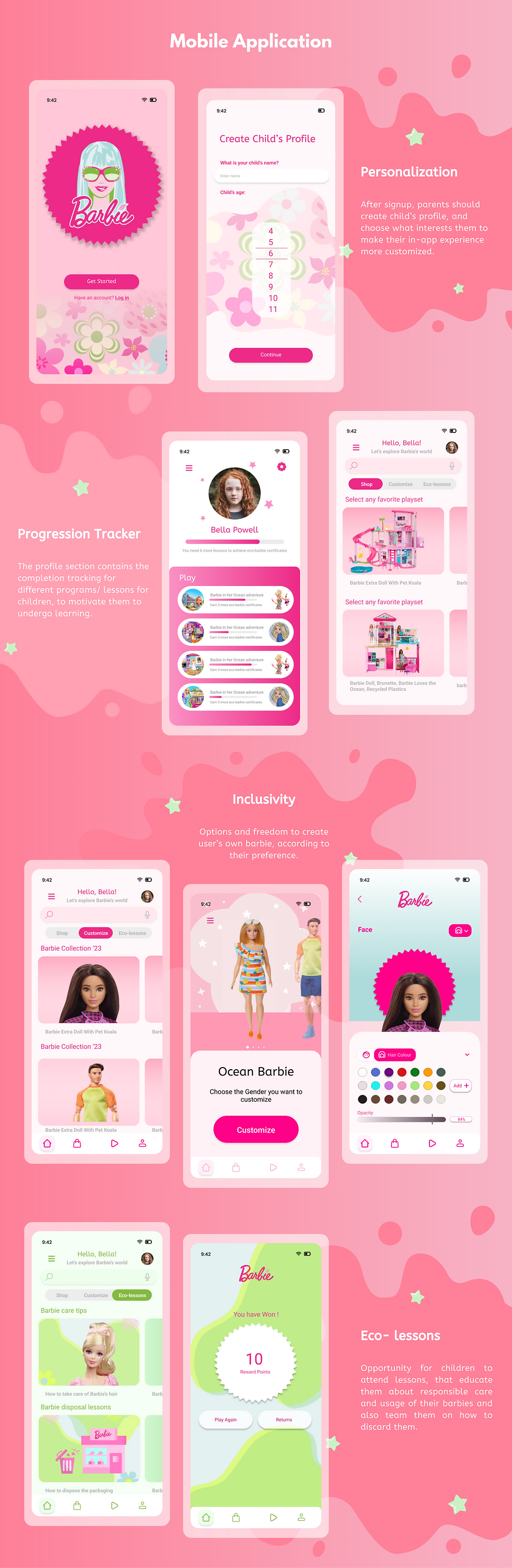
Our new brand service consists of 4 touchpoints - social media, apps, in-store and packaging, and these 4 touchpoints are interconnected. This new service is designed to create a seamless, inclusive experience for customers while raising awareness of sustainability and changing their environmental mindset.
The first stage is introduction to new brand, where customers will learn about the new brand through advertisements on billboards, social media campaigns and installations in retail stores. Afterward, they will download the app, browse and try to customize their own virtual barbie, purchase new barbies through the app, take an eco-lessons to earn rewards, and use rewards to send back for repair. Following this, customer can visit a retail store to repair, exchange, or donate their old barbie at the machine or drop at the nearest barbie store to return it. With the eco-lesson, customers can earn rewards that will motivate them to practice sustainable practices in the future.

